 how-to
Getting Fair Value for Scrap Gold: A 2026 Guide
Table of Contents
- Understanding Gold Purity and Karat Ratings
- How to Spot Fake Gold Jewelry Before You Sell
- How to Weigh Gold Jewelry at Home Accurately
- Calculating Melt Value and Spot Price
- Using a Scrap Gold Calculator to Verify Offers
- Getting Fair Value for Scrap Gold: Avoiding Common Lowball Tactics
- Professional Testing and Mobile Appraisal Services
- Frequently Asked Questions
Last Updated: September 25, 2026
Understanding Gold Purity and Karat Ratings
Gold purity is measured in karats. Pure gold is 24 karats (100% gold content), but most jewelry uses lower karats because pure gold is too soft for everyday wear.
Here's how the karat system breaks down:
- 24K gold: 99.9% pure gold (very soft, rarely used for jewelry)
- 22K gold: 91.7% pure gold (common in coins and some jewelry)
- 18K gold: 75% pure gold (popular for fine jewelry)
- 14K gold: 58.3% pure gold (most common in jewelry)
- 10K gold: 41.7% pure gold (durable but lower gold content)
When you're getting fair value for scrap gold, the karat rating directly affects your payout. Higher karat means more pure gold, which means higher value. A 24K gold coin is worth significantly more than a 10K gold ring of the same weight.
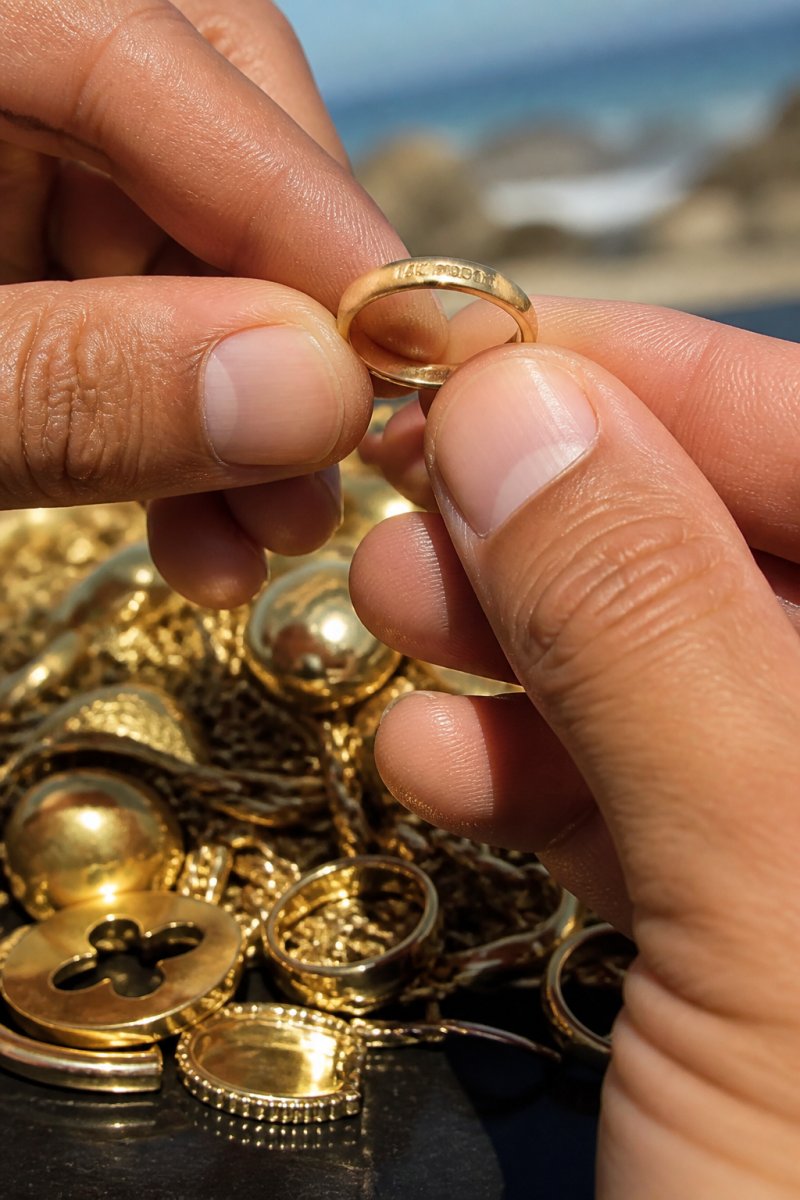
Look for karat stamps on the inside of rings, bracelets, or necklaces. If you can't find a stamp, that's a red flag, it might not be real gold.
How to Spot Fake Gold Jewelry Before You Sell
Fake gold looks real at first glance, but simple home tests protect you from lowball offers and give you documented evidence to challenge a buyer's purity claims.
The magnet test is your first line of defense. Real gold isn't magnetic. If the piece sticks to a strong magnet, it contains ferrous metal, either it's fake or gold-plated over steel.
Gold is dense and heavy for its size. If a piece feels too light, it might be plated rather than solid. A 14K ring should feel noticeably heavier than costume jewelry of similar size.
Real gold should have uniform color throughout. Fake gold often shows wear patterns where plating flakes off, revealing a silvery or reddish base metal at edges, clasps, or high-friction areas.
The acid test is highly reliable for establishing purity. Acid test kits use different acid strengths to verify karat purity. When you apply acid to a small scratch, the color reaction tells you the karat rating, creating a clear visual record.
Home testing strengthens your negotiation position. When a buyer claims your gold is lower karat than the stamp indicates, you can reference your acid test results. Buyers rarely push back when they know you've done your homework.
If your acid test conflicts with the buyer's assessment, ask to see their results in writing and request a second test spot. A legitimate buyer explains discrepancies; one who dismisses your results and pressures you is signaling bad faith.
Document your findings: write down the date, piece, test method, and result. Keep the kit and test strip as physical evidence for buyer meetings.
How to Weigh Gold Jewelry at Home Accurately
Weighing your gold at home gives you a baseline before meeting with a buyer. A basic digital scale works fine for getting fair value for scrap gold calculations.
Use a digital kitchen scale or jewelry scale that measures in grams, the standard for gold trading. Place a small dish on the scale, zero it out, then add your gold piece.
Record the weight and karat rating of each item separately. This documentation matters when you meet with a buyer.
Pennyweight is another common measurement in gold trading. One pennyweight equals 1.555 grams. If a buyer quotes prices in pennyweight, you can convert: divide your gram weight by 1.555 to get pennyweight. Knowing both measurements helps you verify calculations.
Troy ounce is the third measurement you'll hear. One troy ounce equals 31.1 grams. Larger collections are often weighed in troy ounces. Understanding all three systems prevents confusion during negotiations.
Calculating Melt Value and Spot Price
Melt value is what your gold is worth based on current market prices. It's calculated by taking the spot price of gold and multiplying it by the purity percentage and weight of your specific pieces.
The spot price fluctuates daily based on global markets. You can find the current spot price on financial websites and precious metals dealer sites. The spot price is quoted per troy ounce for pure gold.
Here's the basic calculation: Take the spot price per troy ounce, multiply by the purity percentage (14K is 0.583, for example), then multiply by your gold's weight in troy ounces. That gives you the raw melt value before any dealer margin.
Example: If spot price is $2,000 per troy ounce, you have a 14K ring weighing 3.2 grams (0.103 troy ounces), the calculation looks like this: $2,000 × 0.583 × 0.103 = approximately $120 in melt value.
Real offers will be lower than melt value because dealers take a margin for refining and processing. Typical margins range from 10% to 25% depending on the buyer. A transparent dealer explains their margin upfront.
Using a Scrap Gold Calculator to Verify Offers
A scrap gold calculator removes guesswork from your valuation, but it only shows half the picture. These tools let you input your gold's weight, karat rating, and current spot price to see the melt value. The critical mistake sellers make is treating melt value as the offer they should expect. It isn't.
Most online calculators are free and straightforward. Enter the weight in grams, select the karat rating from a dropdown, and the calculator pulls the current spot price automatically. The result shows you the melt value instantly. For example, if you have 5 grams of 14K gold and spot price is $2,000 per troy ounce, the calculator might show $190 as your gold's melt value.
Here's where calculators mislead you: that $190 is the theoretical value of pure gold content. It is not what you will be offered. Buyers deduct refining costs before paying you, and those costs are not visible in a calculator.
The hidden costs buyers deduct:
- Assay fee: A professional test to verify purity and weight. Ranges from $10-$50 per batch depending on the refiner.
- Smelting and refining loss: When gold is melted and processed, a small percentage is lost as waste or oxidation. Refiners typically deduct 0.5%-2% of total weight.
- Refining margin: The buyer's profit for processing your gold and converting it to pure bullion. This ranges from 10%-25% depending on the buyer's business model and refining costs.
- Shipping and insurance (if applicable): If you mail gold to a refiner, they deduct shipping costs and insurance from your payout.
A realistic example: Your calculator shows $190 melt value.
How to use a calculator strategically:
Getting Fair Value for Scrap Gold: Avoiding Common Lowball Tactics
Lowball offers are the biggest challenge when selling gold. Unscrupulous buyers use several tactics to convince you your gold is worth less than it actually is.
Professional Testing and Mobile Appraisal Services
Professional appraisers use certified equipment that gives you absolute confidence in your gold's authenticity and value. These services eliminate doubt and protect you from lowball offers.
Frequently Asked Questions
How is the value of scrap gold determined?
Scrap gold value depends on three factors: purity (measured in karats), weight (in troy ounces or pennyweights), and the current spot price of gold. A dealer multiplies your gold's weight by the day's spot price, then applies a payout percentage, typically 70-85% of melt value, to account for refining costs. The higher your karat rating and weight, the more you'll receive. Always verify the spot price independently before accepting an offer.
What should I know before selling my gold jewelry?
Before selling, identify the karat rating (check hallmarks), weigh your items accurately, verify the current spot price, and understand what payout percentage to expect. Remove any gemstones or non-gold attachments. Know that broken jewelry, dental gold, and coins all have value. Get multiple quotes to compare offers, and avoid dealers who won't explain their testing process or refuse to show you certified scales. Transparency is a sign of a trustworthy buyer.
Can I use a scrap gold calculator to verify what I'm being offered?
Yes. A scrap gold calculator lets you input your gold's weight and karat purity to estimate melt value based on the live spot price. This gives you a baseline to compare against dealer offers. However, remember that calculators show theoretical melt value, not what you'll actually receive, dealers apply a payout percentage (typically 70-85%) to cover refining and operational costs. Use the calculator as a negotiation tool, not a guarantee of price.
How can I tell if my gold is real or fake?
Check for hallmarks (stamps showing karat rating like 14K or 18K) on the jewelry itself. Real gold is denser than most fakes, so genuine pieces feel heavier than they look. The magnet test helps: real gold isn't magnetic, so if a magnet attracts it, it's likely fake or plated. An acid test (available in DIY kits) can verify purity, though professional assay equipment is more reliable. When in doubt, ask a certified buyer to test your items before committing to a sale.
Getting fair value for scrap gold requires knowledge, verification, and confidence. You've learned how to identify real gold, calculate actual value, and spot common lowball tactics. When you're ready to sell, choose a buyer who brings certified equipment to you, explains their pricing transparently, and respects your time. Pirates Finds Gold offers free appraisals with no pressure, get a quote today and see exactly what your gold is worth.