 how-to
Sell Gold Jewelry for Cash Today: A Complete Guide
Table of Contents
- How to Determine the Value of Your Gold Jewelry
- How to Identify Gold Karat Markings and Purity
- Where to Sell Gold Jewelry for Cash
- How to Sell Broken Gold Jewelry Without Losing Value
- Best Practices for Selling Gold Safely and Securely
- Pawn Shops vs. Professional Gold Buyers: What You Need to Know
- How to Avoid Gold Selling Scams and Verify Fair Pricing
- Conclusion
- Frequently Asked Questions
Last Updated: September 27, 2026
How to Determine the Value of Your Gold Jewelry
Understanding karat weight, current spot price, and total weight puts you in control when selling gold jewelry for cash. These three factors determine your payout.
Karat weight indicates purity. Common jewelry karats are 10K (41.7%), 14K (58.3%), 18K (75%), and 22K (91.7%). Higher karat means more gold content and higher cash value.
The spot price fluctuates daily and is the per-troy-ounce baseline professional buyers use. Reputable buyers convert your weight to troy ounces, multiply by current spot price, and adjust for karat purity. This transparent calculation ensures fair market value.
Use a digital scale accurate to 0.1 grams to weigh items before selling, giving you realistic expectations of your payout.
How to Identify Gold Karat Markings and Purity
Every legitimate gold piece carries a hallmark stamp indicating karat weight, usually found on the inner band of rings, inside bracelet clasps, or on pendant backs.
Common stamps include "10K," "14K," "18K," "22K," "585," "750," and "999." Older pieces marked "GP" (gold plated) or "GF" (gold filled) have minimal resale value. European pieces use different systems but follow the same principle: the mark indicates purity.
Faded hallmarks can be verified through acid testing or electronic X-ray fluorescence testing, which identify gold content without damage.
Reputable buyers test items on-site in front of you and explain results clearly, ensuring transparency and protecting you from underhanded tactics.
Where to Sell Gold Jewelry for Cash
Several options exist for selling gold jewelry for cash, each with distinct advantages and drawbacks.
Local jewelry buyers offer immediate cash and on-site testing, but prices vary widely depending on overhead and profit margins.
Pawn shops are quick but offer the lowest payouts since gold is a side business. Use only if you need immediate cash with no alternatives.
Mail-in gold buyers send prepaid kits and wire payment after testing. This works for large collections but requires 5-7 days and you lose direct control. Reputable services allow offer rejection with free returns.
Online platforms connect you with vetted buyers and handle logistics. Some offer video appraisals before commitment.
Estate and antique dealers may offer premium prices for vintage or rare pieces with collector value beyond gold content.
Pirates Finds Gold operates as a mobile buyer throughout San Diego, coming directly to your home or office. We accept all forms of gold, jewelry, coins, bullion, and dental gold, regardless of condition or karat weight. With certified testing equipment and live spot-market pricing, you receive transparent valuations on the spot. We meet near a bank or police station near you for safety and convenience.
How to Sell Broken Gold Jewelry Without Losing Value
Broken jewelry retains full gold value. A snapped chain, missing stone, or bent bracelet still contains the same gold content.
Separate broken from intact pieces before selling to prevent buyers from grouping everything as "scrap" and offering lower rates.
Missing stones don't reduce gold value. If your ring has a lost diamond or gemstone, the gold band's worth remains unchanged. However, some buyers may deduct a small amount if settings are damaged beyond repair. Transparent buyers explain this upfront.
Bent or dented gold is still pure gold. Cosmetic damage doesn't affect purity or weight. A professional buyer tests the gold content regardless of appearance and pays based on that content, not condition.
Solder joints and mixed metals in settings complicate the picture. If your ring has gold solder connecting the band to a setting, or if the setting itself is made of another metal, a buyer accounts for this. Quality buyers test the gold portion separately and calculate your payout accordingly. This is where certified testing equipment matters, it identifies exactly what percentage of your piece is actual gold.
When selling broken gold jewelry, ask the buyer to explain how they're handling mixed metals or soldered components. Reputable buyers break down their calculation so you understand why your payout reflects the actual gold content, not the item's original retail value.
Best Practices for Selling Gold Safely and Securely
Safety and transparency are non-negotiable when you sell gold jewelry for cash. Protect yourself with these proven practices.
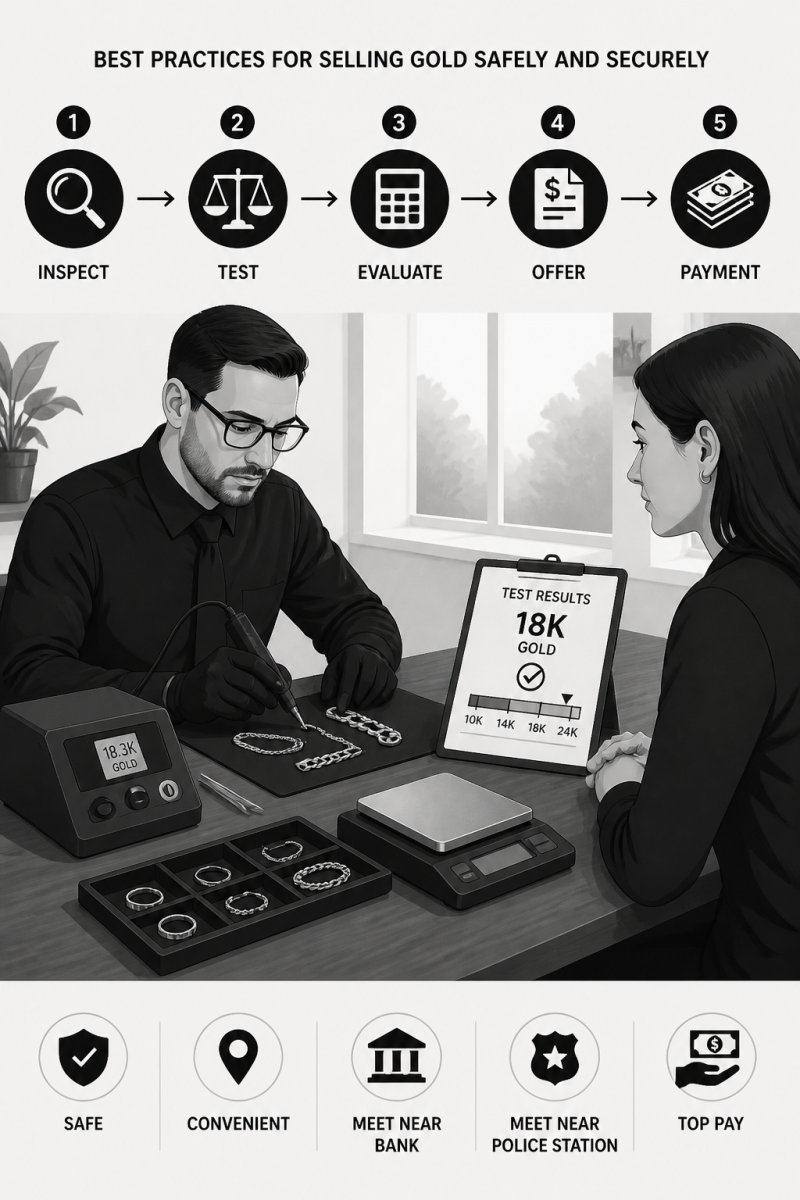
Meet in a secure location. If you're meeting a buyer outside your home, choose a public place near a bank or police station. Pirates Finds Gold accommodates meeting requests at neutral locations near a bank or police station for safety and convenience.
Bring a trusted companion. Having a friend or family member present during the transaction provides an extra layer of security and a witness to the evaluation process. This is especially important if you're selling a significant collection.
Watch the testing process. Legitimate buyers test your gold in front of you and explain each step. If a buyer asks you to wait in another room or rushes through testing, that's a red flag. You have every right to observe how they determine purity and weight.
Document everything. Take photos of your gold items before the meeting. Write down what you're bringing, the approximate weight, and any identifying marks. After the transaction, ask for a receipt that lists each item, its tested karat weight, the weight in grams or troy ounces, and the per-unit price used in the calculation. This documentation protects you if disputes arise later.
Verify the spot price. Before you sell, check the current gold spot price on a financial website. Buyers typically pay a percentage of spot price (usually 70-90% depending on the market and their business model). If a buyer's offer seems drastically lower than your calculation based on current spot price, ask for clarification. A transparent buyer can explain their margin.
Request your preferred payment method. Cash is immediate but not always practical for large amounts.
Pawn Shops vs. Professional Gold Buyers: What You Need to Know
| Buyer Type | Speed | Price Offered | Testing Transparency | Best For |
|---|---|---|---|---|
| Pawn Shop | Immediate | 50-70% of spot | Variable | Quick cash, small amounts |
| Local Jewelry Buyer | Same-day | 70-85% of spot | High | Medium collections, local preference |
| Mail-In Service | 5-7 days | 75-90% of spot | Video/documented | Large collections, convenience |
| Mobile Buyer | Same-day | 75-90% of spot | In-person | Privacy, no travel |
Pawn shops are fast and accessible, but they're not specialized gold buyers. Their business model relies on reselling items quickly at a markup, which means they offer conservative prices. If you need cash today and have a small amount of gold, a pawn shop works. But if you're selling a meaningful collection, you'll receive significantly less than a professional buyer would offer.
How to Avoid Gold Selling Scams and Verify Fair Pricing
Scams targeting gold sellers exploit urgency, inexperience, and the difficulty of verifying spot prices on the fly. Protect yourself by knowing the common tactics.
Ask any buyer these questions:
- What testing method are you using, and can I watch?
- What spot price are you using, and when was it updated?
- Can you show me the weight and purity in writing before payment?
- What percentage of spot price are you offering, and why?
Transparent answers build confidence. Evasive responses are warning signs.
Conclusion
Selling gold jewelry for cash doesn't require guesswork or risk. When you understand karat markings, know how to verify weight and purity, and meet with a transparent buyer, you control the outcome. The difference between a fair deal and a bad one comes down to preparation and choosing the right buyer.
Frequently Asked Questions
What is the best way to sell gold jewelry for cash?
The best approach involves three steps: First, determine your gold's purity by checking hallmarks (stamps showing karat weight like 10K, 14K, or 18K). Second, get multiple appraisals from reputable buyers who use certified testing equipment and price against the live spot price. Third, choose a buyer offering transparent pricing, no-pressure transactions, and secure payment methods. Mobile buyers who meet near a bank or police station offer convenience and privacy, while professional gold buyers typically provide more detailed appraisals than pawn shops.
How can I ensure I am getting a fair price for my gold jewelry?
Fair pricing depends on three factors: the current spot price (the market rate for pure gold), your gold's purity (measured in karats), and the weight in troy ounces. Before selling, research the day's spot price and calculate approximate value using your item's karat weight and scale weight. Request a detailed verbal appraisal that breaks down these components. Reputable buyers will test your gold using acid tests or other certified methods and explain their pricing transparently. Avoid buyers who rush you or refuse to explain their valuation.
Can I sell broken gold jewelry, or does it need to be in good condition?
Broken gold jewelry is absolutely worth selling. Buyers purchase gold for its metal content (melt value), not its condition or design. Bent, cracked, missing stones, or damaged clasps do not reduce the value of the gold itself. In fact, broken or damaged pieces often sell more easily because the buyer will refine them for their precious metal content. Simply inform the buyer that items are broken or damaged; this does not affect the appraisal process or fair market value calculation.
Is it safer to sell gold jewelry in person or online?
In-person transactions with a mobile buyer or local professional offer the highest security because you can verify testing with certified equipment on-the-spot and receive instant cash payment. This eliminates shipping risks and confirms authenticity immediately. Online mail-in services require you to ship items (with insured shipping) and wait for results, adding time and potential loss risk. Meeting at a secure location near a bank or police station provides safety for both parties. Always verify the buyer's credentials, ask about their testing methods, and never agree to payment before you see results.