 how-to
How to Spot Fake Gold Jewelry: 7 Tests That Work
Table of Contents
- Start With a Visual Inspection and Hallmark Check
- How to Test Gold With a Magnet (And Why It Only Rules Out Fakes)
- The Ceramic Scratch Test and the Vinegar Test
- Gold Acid Testing Kit Instructions: Step-by-Step
- The Water Density Test and Specific Gravity
- Professional Appraisal and XRF Testing: When to Stop Guessing
- Avoid Damage and Spot the Psychology of Gold Scams
- Conclusion: Testing Fake Gold Jewelry at Home vs. Getting a Real Offer
- Frequently Asked Questions
Last Updated: September 19, 2026
Start With a Visual Inspection and Hallmark Check
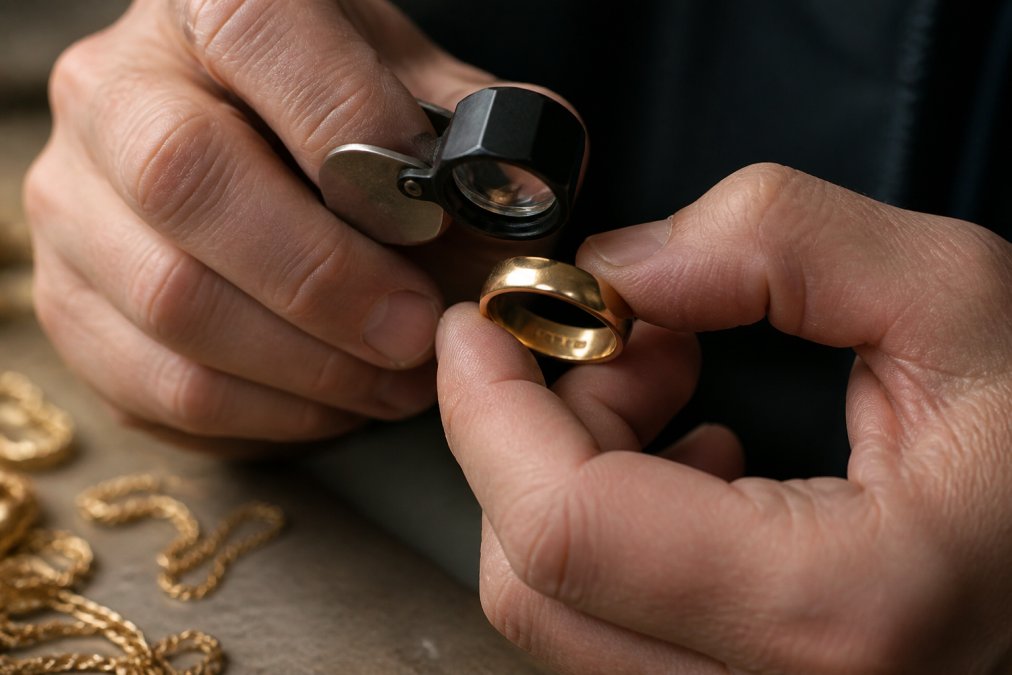
A gold hallmark is a tiny stamp inside a ring, on a clasp, or along a chain that tells you the metal's purity. Learning to read that stamp is the fastest first step in how to spot fake gold jewelry before you spend a dollar on testing.
Here's what to do:
- Use bright light and a loupe or magnifying glass.
- Look on the inner band, clasp, or back of a pendant.
- Check for a number plus "K," "KP," or "GF."
- Note whether the stamp looks crisp or shallow and worn.
Gold Hallmark Meanings: What 10k, 14k, 18k, and 24k Stamps Tell You
The number in a hallmark tells you the karat, which is the share of pure gold in the metal. Higher karats mean more gold and a softer, more scratch-prone piece.
- 10k: about 41.7% gold, the most durable common karat
- 14k: about 58.3% gold, the standard for everyday jewelry
- 18k: 75% gold, richer color, softer metal
- 24k: 99.9% gold, too soft for most jewelry settings
Signs of Gold Plating and Vermeil
Gold-plated jewelry has a thin gold layer over a base metal like copper, nickel, or zinc. Vermeil is sterling silver with a thicker gold coating, and it's often stamped "925" alongside a gold mark.
Watch for these tells:
- A "GP," "HGE," or "GF" stamp instead of a karat number
- Gold color wearing off at edges, clasps, or high-friction spots
- A gray or reddish tone showing through worn areas
- A magnetic pull (the base metal underneath is often magnetic)
How to Test Gold With a Magnet (And Why It Only Rules Out Fakes)
Gold is non-magnetic, so a strong magnet should not pull on a genuine piece. This is one of the easiest ways to test gold with a magnet, but it only works one direction: if the magnet sticks, the item is not solid gold.
How to run it:
- Use a strong neodymium magnet.
- Hold it close to the item, not touching.
- Watch for any pull or jump toward the magnet.
- Repeat on different spots of the piece.
The Ceramic Scratch Test and the Vinegar Test
The ceramic scratch test and the vinegar test are two quick home checks. Both can help, and both can damage or mislead if you're careless.
A few cautions:
- The scratch test can mar a soft or plated piece.
- Vinegar won't catch every fake.
- Neither test confirms karat or value.
Gold Acid Testing Kit Instructions: Step-by-Step
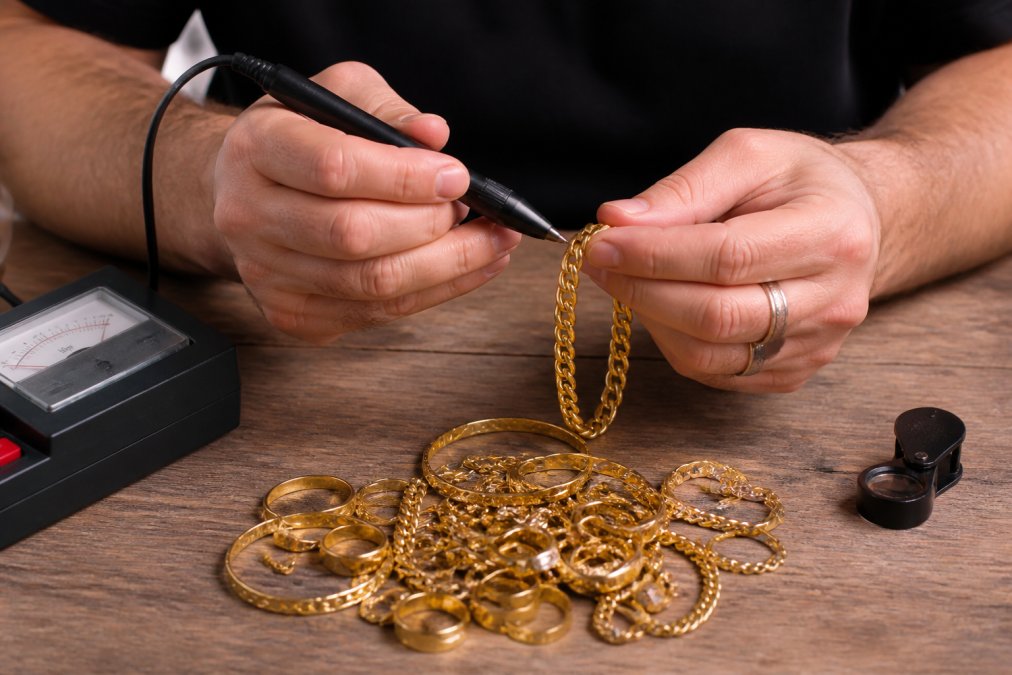
A gold acid test kit uses small bottles of nitric acid blended to react at specific karat thresholds. Follow the gold acid testing kit instructions exactly, because the acid is corrosive, the results are easy to misread, and a careless drop can permanently pit a piece you meant to sell.
Here is the standard process:
- Find a hidden spot on the item, inside a ring band, under a clasp, or on the back of a pendant.
- Rub the item firmly on the touchstone to leave a visible metal streak. A thin, faint streak is hard to read; aim for a solid line.
- Choose the acid bottle for the karat you expect (for example, a 14K bottle).
- Apply one drop to the streak on the stone, never on the jewelry itself.
- Watch the streak for 30 to 60 seconds.
How to Read Acid Test Results
- The streak holds its color and does not dissolve: the item is at least that karat.
- The streak dissolves or fades to nothing: the item is a lower karat or not gold.
- The streak turns green or brown: copper or a copper-heavy alloy is present.
- The streak turns milky or white: the metal is likely silver or a silver alloy, not gold.
Test from low karat to high karat to narrow the range. If a 10K streak survives but a 14K streak dissolves, you are looking at a piece between those two, not a clean 14K.
The Limits of Acid Testing
Acid testing tells you the karat of the surface it touches. It does not detect a thick gold plating over a base metal if the scratch does not cut through the plating, and it cannot read a hollow or filled piece accurately. It also says nothing about stones, weight, or resale value.
Acid test kits use nitric acid. Work in a ventilated space, wear nitrile gloves and eye protection, and keep the kit locked away from kids and pets. Never store the bottles near food, and never mix acids.
Damage Mitigation: Cleaning Up After a Test
This is the step most guides skip. If acid touches the jewelry, even a stray drop, neutralize and rinse it immediately:
- Flush the spot with plain water for at least a minute.
- Dab a paste of baking soda and water onto the area to neutralize residual acid.
- Rinse again and pat dry with a soft cloth.
- For a scratch mark on the touchstone side of a soft piece, a jeweler can usually polish it out; deep pits from acid on the item itself often cannot be reversed.
Test on the touchstone, not on the jewelry itself. Acid on the item can pit the surface and lower its resale value, and no home polish fully restores a pitted finish.
The Water Density Test and Specific Gravity
The water density test compares an item's weight in air to its weight in water. This gives you its specific gravity, and pure gold has a high one, around 19.3 (Gold).
Here's the method:
- Weigh the item dry on a small scale.
- Weigh it again while fully submerged in water.
- Divide the dry weight by the difference between the two.
Professional Appraisal and XRF Testing: When to Stop Guessing
An XRF analyzer reads the exact metal makeup of a piece in seconds without any damage. This is the point where guessing ends and real numbers begin.
When to call a professional:
- The item is worth more than a few dollars.
- You're selling, insuring, or dividing an estate.
- Home tests gave mixed or unclear results.
- The piece has stones or a complex setting.
Avoid Damage and Spot the Psychology of Gold Scams
Home testing can cost you money if you damage a real piece, and most fake-gold losses come from pressure and bad information rather than a failed acid test. This section covers both, the damage you can cause yourself and the scam patterns that separate buyers from their money before any test happens.
Damage Risks and How to Prevent Them
- Scratching a soft piece: 24K and 18K gold are soft and mark easily. A ceramic tile or touchstone scratch on a visible surface can leave a permanent line.
- Pitting with acid: Nitric acid etches metal. A drop on the jewelry, not the stone, can leave a pit that no polish fully removes.
- Bending a hollow chain: Hollow links and rope chains crush under light finger pressure. Support the chain flat on a table instead of dangling it.
- Loosening stones: Ultrasonic cleaners and aggressive scrubbing can shake a prong-set stone free. Skip the ultrasonic on antique or glued settings.
- Stripping plating: Polishing cloths and abrasive pads can wear through gold plating or vermeil, exposing the base metal underneath.
A damage-free alternative is to skip destructive tests entirely and use non-contact checks first: a loupe for the hallmark, a magnet, and a visual check for wear patterns. When a piece is valuable or sentimental, go straight to a professional rather than risk a mark you cannot undo.
Digital Verification for Modern Pieces
Most guides ignore this, but modern luxury and branded jewelry often carries a verifiable identity that a scratch test cannot confirm:
- Serial numbers and model numbers engraved or laser-etched on the piece, often inside a clasp or on a tag.
- Certificates of authenticity from the maker, with a matching serial and sometimes a QR or verification code.
- Brand-specific verification portals where you can enter a serial to confirm the piece was made by that brand.
- Original packaging, receipts, and appraisal documents that tie the item to a legitimate purchase.
The Psychology of Gold Scams
Scammers rely on speed, emotion, and information gaps. Recognizing the pattern is often more useful than any home test:
- Urgency: "Act now," "someone else is looking at it," or a countdown that discourages verification.
- Too-good-to-be-true pricing: A price far below the live spot market for the stated karat and weight. Real gold tracks the spot price; a deep discount usually means plating or a lower karat.
- Cash-only, no-testing offers: A buyer who refuses to show a scale, a test, or a receipt is hiding something.
- Pressure to skip appraisal: "Don't waste money on a jeweler" is a classic line when the item is not what it claims.
- Online marketplace red flags: Stock photos instead of real images, a seller with no history, payment methods with no buyer protection, and listings that avoid the word "plated" or "filled."
- Street and parking-lot scams: A stranger with a "found" ring or a "need cash today" story, often using a plated piece and a hard-luck narrative to rush the sale.
The safest move with any valuable piece is to skip home tests and get a free, no-obligation appraisal. You risk nothing, you avoid damaging the item, and you learn the real number.
Conclusion: Testing Fake Gold Jewelry at Home vs. Getting a Real Offer
Home tests are useful filters, not final answers. A magnet, a ceramic tile, and a bottle of vinegar can flag obvious fakes, but they can't tell you what a piece is actually worth. That gap is where people lose money.
Frequently Asked Questions
What is the easiest way to tell if gold is real?
The fastest first check is a hallmark stamp. Look inside the band or clasp for marks like 10k, 14k, 18k, 24k, or 999, usually paired with a maker's mark. A stamp alone is not proof, since counterfeiters copy them, but a missing or misspelled stamp is a strong warning sign. From there, a magnet test and a ceramic scratch test take under a minute and catch most gold-plated fakes.
Can a ring be real gold if it is not stamped?
Yes, though it is uncommon. Older pieces, handmade jewelry, and items worn down by polishing can lose their stamp over time. Some foreign-made pieces also use different marking systems. If a ring is unstamped but passes the magnet, ceramic, and density checks, a jeweler or a mobile buyer using an XRF analyzer can confirm the karat without damaging it.
Does a magnet test prove gold is real?
No. The magnet test only rules things out. Gold is non-magnetic, so a magnet should not stick to it. If a magnet grabs your jewelry, it contains iron, nickel, or another magnetic base metal, meaning it is fake or heavily plated. But plenty of fakes are also non-magnetic, including brass and copper pieces, so passing the magnet test is not proof of authenticity.
Can vinegar tell if gold is real?
Vinegar is a weak acid, so it only reacts to the most obvious fakes. Real gold does not tarnish or discolor in vinegar. If your jewelry turns black, green, or otherwise changes color after sitting in vinegar for 15 minutes, it is likely gold-plated over a base metal like copper. A piece that passes the vinegar test still needs a stronger acid test or XRF scan to confirm the karat.