 comparison
Gold Buyers USA Alternatives: 2026 Comparison
Table of Contents
- Gold Buyers USA Alternatives at a Glance
- Pirates Finds Gold: Mobile Service With On-Site Testing
- Diamond Banc: National Gold Buyer for High-Value Items
- South Bay Coin: Direct Refinery Pricing and Walk-In Service
- Mail-In Gold Buyers: Bullion Exchanges and Remote Options
- How to Compare Gold Buyers: Key Criteria and Red Flags
- Best Place to Sell Gold Based on Your Situation
- What Happens If You Reject an Offer
- Frequently Asked Questions
Last Updated: October 7, 2026
Gold Buyers USA Alternatives at a Glance
The buyer you choose makes all the difference. A Gold Buyers USA alternative can offer faster service, better transparency, or more convenience, from mobile services to national buyers specializing in high-value items.
What separates the best alternatives: transparency in testing, fair market-based pricing, and honest communication about fees.
| Service | Best For | Key Advantage | How It Works |
|---|---|---|---|
| Pirates Finds Gold | Home convenience & privacy | Mobile service with on-site testing | We come to you; same-day cash |
| Diamond Banc | High-value jewelry & bullion | National reputation & expert appraisals | Mail-in or in-person; insured shipping |
| South Bay Coin | Local in-person sales | Direct refinery pricing | Walk-in service; transparent testing |
| Bullion Exchanges | Bullion investors | Simplified online process | Online portal; market-based pricing |
| Mid-States Recycling | Value estimation first | Free karat calculator tool | Estimate before committing to sale |
Pirates Finds Gold: Mobile Service With On-Site Testing
Pirates Finds Gold operates differently than brick-and-mortar buyers. We come directly to you with certified testing equipment and appraise on the spot, eliminating travel and giving you complete transparency.
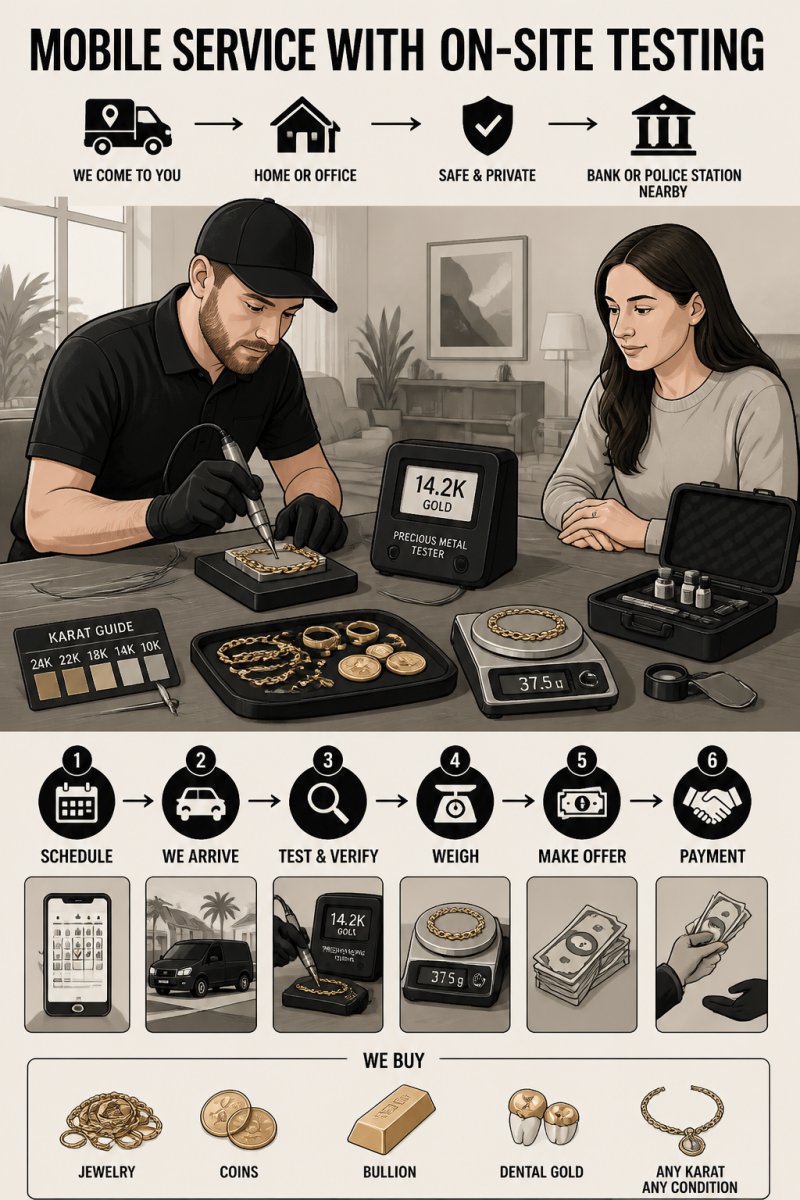
The mobile model solves a real problem: many people have gold at home, inherited jewelry, dental gold, old coins, but are uncomfortable leaving the house.
Our pricing is tied directly to the live gold spot market, not arbitrary markups.
Diamond Banc: National Gold Buyer for High-Value Items
Some national gold buyers operate at scale, handling significant volumes of gold jewelry, coins, and bullion nationwide.
Their strength is complex jewelry where authenticity, craftsmanship, and designer value matter. Appraisers trained to recognize luxury items provide competitive offers based on current market values.
The trade-off: offers require physical inspection, so you ship insured or visit in person. It takes longer than same-day service, but for high-value collections the scrutiny justifies the timeline.
South Bay Coin: Direct Refinery Pricing and Walk-In Service
Some local buyers eliminate the middleman by operating as a direct-to-refinery buyer, so you get refinery pricing instead of dealer markup.
The process is straightforward: walk in, watch your gold tested on-site, and receive a same-day cash offer based on direct refinery rates.
Best for locals who want immediate cash with visible testing. The limitation is geographic, in-person only, not mail-in or mobile.
Mail-In Gold Buyers: Bullion Exchanges and Remote Options
Mail-in buyers serve investors liquidating bullion who don't mind shipping and a timeline delay. Some specialize in this model through their online portal.
The downside: you're not watching the testing, and the timeline stretches to days rather than hours. Mail-in works well for standardized bullion, coins, bars, rounds.
Some mail-in buyers take a different approach with a free karat calculator.
The Mail-In Mechanics Most Sellers Learn Too Late
Mail-in selling has more moving parts than the marketing admits.
Packaging that survives the trip. Use a rigid box, not a paper envelope.
Turnaround timeline. A realistic mail-in cycle runs several business days from drop-off to payout: transit, intake, testing, offer issuance, your decision window, and payment.
Offer windows and expiration. Most offers stay open for a set number of days. Read that window carefully.
Fees, Insurance, and Deductions in Mail-In Sales
Mail-in buyers rarely charge an upfront fee, but the transaction isn't free, the cost usually shows up as a discount to spot rather than a line-item charge.
- Payout discount. The offer is typically a percentage of melt value, not full spot. The gap covers refining, assay, labor, and margin.
- Return shipping. If you reject the offer, most reputable buyers return your items at their expense. Confirm in writing before shipping.
- Insurance during return. The return shipment should be insured at the same declared value you sent. Ask who pays.
When Mail-In Beats a Local Sale
Mail-in makes sense when the item is standardized and the buyer's premium is thin. Bullion coins, bars, and rounds trade on well-known purity and weight, so testing risk is low and the buyer's discount is the main variable.
Mail-in makes less sense for one-off jewelry, dental gold, or anything with condition, maker, or stone value a photo can't capture. Those reward an in-person look where you watch the test and negotiate on the spot.
A Practical Checklist Before You Ship
- Confirm the declared value limit on the shipping label.
- Confirm who pays return shipping if you decline.
- Confirm the offer window in days.
- Confirm the payment method and how long deposit takes after acceptance.
- Photograph contents, packaging, and the sealed box with the label visible.
- Keep the tracking number and the intake confirmation email.
Run that checklist against any mail-in buyer and the process stops feeling like a black box, you'll know exactly what you're agreeing to before the box leaves your hands.
How to Compare Gold Buyers: Key Criteria and Red Flags
Gold Testing Methods and Verification
The testing method determines accuracy.
Acid testing is traditional: a small scratch exposes the metal, acid of known strength is applied, and the reaction indicates purity.
XRF testing is non-destructive and precise, the machine reads metal composition without damaging your gold.
Weight-based calculation works when you know the karat rating: the buyer weighs the item, applies the karat percentage, and calculates melt value.
Red flag: a buyer who won't let you watch the testing or who tests in a back room.
Fees, Commissions, and Payout Transparency
This is where many gold buyers hide their real margin. Understand the fee structure before you commit.
Some charge a flat commission, typically 10-20% of calculated value. Others use a "buy price" already discounted from spot.
The best buyers are transparent upfront: they show you the spot price, the calculation, the fee, and the final payout.
Ask directly: "What percentage of spot price am I receiving after all fees?" A legitimate buyer answers immediately with a specific number.
Best Place to Sell Gold Based on Your Situation
Scenario 1: You want same-day cash without leaving home. Pirates Finds Gold is the clear choice.
Scenario 2: You're selling high-end inherited jewelry or significant bullion. For high-end inherited jewelry or significant bullion, an expert appraisal can justify a longer timeline, ensuring you're not leaving money on the table.
Scenario 3: You're local and want direct refinery pricing with immediate cash. Some local buyers deliver. Walk in, watch the testing, get paid same day at refinery rates.
Scenario 5: You want to estimate your gold's value before selling. A karat calculator can be a planning tool: understand your gold's worth, then decide which buyer to approach.
Pirates Finds Gold is best for busy professionals, estate executors, and anyone prioritizing convenience and transparency over everything else. The mobile service eliminates friction. Same-day payment removes waiting. Certified on-site testing removes doubt.
What Happens If You Reject an Offer
This is where buyer integrity shows. Rejecting an offer is normal, not a confrontation. What matters is what happens to your gold, how long it takes to return, and who pays for the trip.
In-Person Rejections
If you decline in person, the transaction ends there: you keep your gold, walk out, and no fee should apply. A legitimate buyer hands your items back immediately without asking for a testing fee, restocking charge, or deposit.
Some buyers will ask why you declined. That's fine and can be useful if they explain their calculation, but the decision is yours alone, a no-obligation quote means exactly that.
Mail-In Rejections
Mail-in rejections matter most because your gold is already in someone else's hands. Before you ship, get four answers in writing:
- Who pays return shipping? Reputable buyers cover the cost of returning declined items. A buyer that charges you is shifting risk onto you after you've given up possession.
- How is the return insured? The return shipment should be insured at the same declared value you sent. Confirm the carrier and coverage amount.
- What is the return timeline? Ask for a specific number of business days from your rejection to the package leaving their facility.
Dispute Resolution and Escalation
If a buyer returns different or damaged items, or refuses to return them at all, start with a written complaint to customer service by email so you have a record. If that fails, escalate in this order:
- The buyer's formal complaint process. Many national buyers publish a dispute or arbitration procedure. Follow it in writing.
- Your state attorney general's consumer protection division. Every state has one, and they accept complaints about precious metal dealers.
- The Better Business Bureau. Not a regulator, but a public complaint record that other sellers check.
- Local law enforcement. If the value is significant and you believe a crime occurred, file a police report. Your photographs of the contents and sealed package become evidence.
For high-value disputes, a consumer protection attorney can send a demand letter.
How to Verify a Buyer Before You Ever Ship
A few minutes of checking prevents most rejection problems:
- Search the business name plus "complaint" and "lawsuit." Look for patterns, not one-off reviews.
- Check your state's licensing database. Some states require precious metal dealers to register, confirm the registration is current.
- Read the terms of service. The return policy, offer window, and insurance terms should be in writing, not just on a phone call.
A buyer's rejection policy tells you more about their integrity than their marketing does. If return shipping, insurance, and timelines are not in writing before you ship, you are accepting risk you did not agree to. Ask first, ship second.
Frequently Asked Questions
What are the best alternatives to Gold Buyers USA?
The best alternatives depend on your situation. Pirates Finds Gold offers mobile service with on-site testing and same-day cash payment, ideal for convenience and privacy. For high-value jewelry nationwide, professional appraisals are available. Some local buyers provide direct refinery pricing with in-person testing. Mail-in buyers work well for bullion holdings. Each option differs in fees, turnaround time, and gold testing methods, so compare based on your item type and preferred selling method.
How can I compare gold buyers before selling jewelry?
When comparing gold buyers, evaluate testing transparency (do they test in front of you?), fee structures (are commissions clearly stated?), payout method (cash, check, or electronic transfer?), and turnaround time. Verify the buyer's reputation through customer reviews and check whether they accept your item type (jewelry, coins, dental gold, bullion). Request quotes from multiple buyers, no-obligation offers let you compare without commitment. Ask how they determine spot price and whether they offer insurance for shipped items.
Should I use a mail-in gold buyer or sell locally?
Mail-in gold buyers work best if you have bullion or high-volume holdings and prefer convenience over immediate payment. Local buyers offer same-day testing, instant payment, and the ability to watch the appraisal process. Mobile services combine both benefits: they come to you, test on-site, and pay immediately. Choose mail-in if turnaround time isn't urgent; choose local or mobile if you want verification, privacy, and cash the same day.
How do gold buyers test jewelry and coins to determine value?
Professional gold buyers use certified testing equipment like electronic scales, acid testing kits, or X-ray fluorescence (XRF) machines to verify karat purity and weight. Reputable buyers test items in front of you so you can see the process. They then calculate melt value based on the current gold spot price, karat percentage, and weight. Some buyers use free estimation tools to help you understand potential value before selling. Always ask the buyer to explain their testing method and show results.
What should I do before accepting a gold buyer's offer?
Before accepting an offer, verify the buyer's testing results match your expectations. Ask for the breakdown: weight, karat purity, and spot price used. Get quotes from at least two buyers to ensure the offer is competitive. Check customer reviews and verify the buyer's reputation and legitimacy. Confirm the payment method, timing, and any fees or deductions. Request the offer in writing so you have documentation. If you're uncomfortable with the price, you have the right to reject the offer with no obligation, legitimate buyers never pressure you to sell.
Selling gold doesn't require settling for pressure tactics or opaque pricing. The Gold Buyers USA alternatives we've covered offer different advantages depending on your situation. If you value convenience, transparency, and same-day payment, Pirates Finds Gold brings professional appraisal directly to your location with certified testing equipment and fair market-based pricing. Get a free quote and see exactly what your gold is worth, no pressure, no obligation.